Thursday, 30 July 2015

Move along now: the reader journey gains momentum


If you've stumbled onto this blog about my digital biography/"zoeography" of William Hayley for the first time, you may want to read my initial post about the project – as well as the two I've linked to above – before going any further with this one, so it makes sense.


A few weeks since my last post on the HayleyWorld reader journey, and some of the questions I posed have been quietly answering themselves while I've been getting on a) with writing and b) other stuff. Lots of other stuff.


So, here's the latest version…

1. Reader journey design: phase 3

As you can see from comparing phase 3 (above) to phase 2 (below)
Reader journey design: phase 2
… I've moved on both conceptually and creatively, and also started using Omnigraffle - which is much more suitable (and fun) than Word for this sort of thing.

What's also interesting is the way a slight delay in technical implementation (down to my brilliant development partner Contentment's commercial commitments) has facilitated this surge forwards. Had we been further forward with the technical and visual development of the HayleyWorld app, I would have written more commentary on the edited extracts from Hayley's Memoirs that sit at the centre of the zoeography. But my thinking about how it all fits together, and the different ways in which the app will be personalised and function create the illusion of a relationship between Hayley and his readers wouldn't be anywhere near as advanced.

Next week - Semantic Web for the Working Ontologist: chapter 14 (you can read my take on chapter 13 here).

In the meantime, hurrah for obstacles.

Thursday, 23 July 2015

Semantic Web for the Working Ontologist: Chapter 13


After all last week's, er, 'excitement', it's back to my attempt to grasp the theory of data modelling, RDF and its various iterations, OWL and associated concepts.

First off, I need to say there's something in chapter 13 – title: Ontologies on the Web—putting it all together – that I really don't get, and that's the use, in the section on Dimension checking in QUDT (the acronym for a specific ontology: Quantities, Units, Dimensions, Types) of vectors as a way of representing signatures for compound quantities.

When I say I don't get it – I understand the principle, that "QUDT defines eight basic quantities", including "length, time and mass", and that the process of dimensional analysis requires that units used to measure compound quantities require a signature showing how the … Oh…

Hang on … what I was going to say here was that I didn't understand how the vectors providing the signature for how these compound quantities are comprised from the eight basic quantities/units are calculated. Why, say, if "we write our vectors in the order [length, mass, time] then the vector for velocity is [1, 0, -1]", even though the authors explain how "the magnitude of the vector in that component begin the exponent of the the base quantity in the formula for the compound quantity".

I'd read that page at least four times before giving up. But it's just this second clicked. The vector for velocity is [1, 0, -1] because velocity = length/time. The zero's there because mass isn't a factor. Duh. Remarkably, I did pass maths A level. But only just, and with a lot of tutoring. And it was a loooooong time ago now…

Chapter 13 introduces and outlines the uses of three online ontologies: QUDT, Good Relations and ChEBI – Chemical Entities of Biological Use – which "is published as part of the Open Biological and Biomedical Ontologies Foundry (OBO)".

Developed by NASA, "the goals of QUDT are to provide
  1. A standardized consistent vocabulary, focused on terminology used in science and engineering.
  2. A set of consistent coded identifiers, for human and machine use.
    1. nd machines, avoiding problems with uncertainty and misinterpretation.
  3. A collection of foundational vocabularies that can serve a variety of applications.
  4. A framework designed for extensibility and evolution, but model-based (instead of just a typical dictionary) and governed."
Outside of engineering, it's widely used for online currency conversion.

The Good Relations ontology is used for commerce. It provides search engines with rich information about products and services, enabling them to assess the relevance of the the product or service to the "location, time, identity, profile, and preferences of the person behind the query" (from GoodRelations).The authors provide an example of how it can be used by a nail bar that also offers massages, both to publicise its services and to enable browsers to work out which service, provided by comparable beauty salons, offers the best value massage per minute.

And CheBI is
"a freely available dictionary of molecular entities focused on ‘small’ chemical compounds. The term ‘molecular entity’ refers to any constitutionally or isotopically distinct atom, molecule, ion, ion pair, radical, radical ion, complex, conformer, etc., identifiable as a separately distinguishable entity. The molecular entities in question are either products of nature or synthetic products used to intervene in the processes of living organisms." (from the ChEBI website)

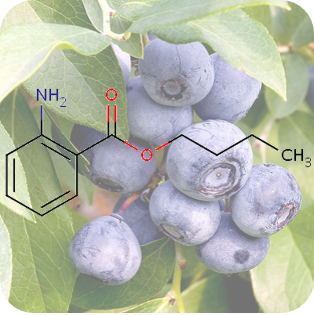
Incidentally the ChEBI website features an "Entity of the Month". At the time of writing it's butyl anthranilate, a naturally occurring substance that scientists are currently testing as a safe insect repellent to protect fruit – and, potentially, people – from being eaten/bitten by flying insects…

ChEBI's Entity of the Month for July 2015. And some blueberries.
The authors also introduce the term owl:imports which allows one ontology to refer explicitly to another, and enables inferences to be drawn from the imported ontology within the ontology into which it has been imported.

That's it for this week. And, just so you know, there are three, short chapters to go…

Saturday, 18 July 2015

Don't have a heart attack in Westfield

"I will call an ambulance on my mobile.… [pause]. It isn't going through. You try too"

 We – me, my 15 year old daughter and a Westfield security guard who claims to be a first aider, are outside some toilets in the shopping centre after my daughter has collapsed, dizzy, nauseous and with pains in her head, neck, arms and legs.

There is no signal on the mobile phone, and, for several minutes the guard keeps pressing redial while refusing to ask someone to call an ambulance on a landline, because…er, I'm not entirely sure why, but it's something to do with the fact that she's still breathing and just about conscious. He's suggesting we catch a taxi to the Hammersmith Hospital, fails to do anything about my request for a wheelchair, but responds to my agitation by suggesting that if I want to complain about him, I should go to the concierge and do so.

If you're tempted to shop 'til you drop, don't.

For some strange reason – oh yes, I'm sitting with a sick, scared and distressed teenage girl collapsed across my lap – I choose not to do that, but instead shout at him until he calls his manager. Eventually he does, and Nubia, who arrives shortly afterwards, is calm, decisive and effective. A wheelchair is brought, and we race my semi-conscious child to the taxi-rank, where a taxi driver takes us, reluctantly – "you should have called an ambulance" – "YES I KNOW THAT" – to the Hammersmith Hospital a few minutes away.

The Hammersmith. Highly recommend the Urgent Care Centre there

Staff at the hospital, especially the lovely and on-the-ball healthcare assistant Ifrah  – and at St Mary's where they have to send us later because she's under 16 – are wonderful. As are Jonathan, who helps us at Westfield and leaves his mobile number so I can let him know that my daughter's ok, the mixed-race boy who dashes into the hospital to bring us a wheelchair and the young Muslim woman and her two older male companions who are walking past the Hammersmith, and help us into the hospital, providing encouragment as well as physical support, after the taxi driver drops us across the street and my daughter falls on the pavement and can't get up.


I didn't get their names, but am hugely grateful. This kindness of strangers was deeply touching.

***

Luckily, there was nothing seriously wrong: my daughter had had a bad reaction to the beta blockers a specialist had prescribed a couple of days previously as migraine prophylaxis (a standard approach).

In this instance, Westfield's poor emergency response caused no long term harm. But – now my daughter has recovered, and I've caught up with everything I need to do (okay, apart from the housework) – I will complain.

Because if I don't, one day someone might have a stroke or a cardiac arrest in the centre, And the outcome is unlikely to be so happy.

Next week I'll be back with chapter 13 of Semantic Web for the Working Ontologist.

Thursday, 9 July 2015

Semantic Web for the Working Ontologist: Chapter 12

Data modeling gets intricate

This week, it's "Counting and sets in OWL". Intricate stuff for a newbie data modeler, and takes me back to A level maths (I scraped a pass. With tutoring).

As the title suggests there's a lot of set theory here. The chapter kicks off with a reminder about restrictions and how they can be used
  • "to define notions like Vegetarian"
  • "to sift information from a table"
and
  • "to manage groups of people"

Intersections, unions and other class relationships 

The rest of the chapter then covers how combining restrictions with the set theory language provided in OWL enables complex and precise relationships and identities to be defined. OWL set theory language includes
  • intersections: an intersection of two or more classes = a new class owl:intersectionOf
  • unions: all the members of all the classes combined owl:unionOf
  • complements: " the complement of a set is the set of all things not in that set". owl:complementOf. This needs to be used with care as say, the complement of the set of, say, everyone in the Iranian women's football squad includes not only everyone in Iran who isn't in the national football squad, but everything else in the known (and unknown) universe: animate, inanimate and other*.
  • disjoints - two sets with no members in common. eg: ":Meat owl:disjointWith :Fruit"
and is complemented (but not in the set theory sense) by OWL's use of cardinalities: these refer to "the number of distinct values for a particular property some individual has".

Anyone can (still) Say Anything about Any topic 

Given the Open World Assumption – Anyone can say Anything about Any topic – this can be a tricky value to establish in many instances. However, there are some numeric values that do stay stable for long enough for, at least, upper and lower limits to be articulated. For example, the number of people on each team at the start of a league football match will be n=11 (owl:cardinality 11). The number of people in the squad from which the team is picked will be >11 (owl:minCardinality 12).

"Cardinality refers to the number of distinct values a property has".

n=11
There is also, naturally, owl:maxCardinaity

Using owl:oneOf closes a set, but, given the Open World assumption, it should only be applied judiciously, "in situations in which the definition of a class is not likely to change – or at least not change very often".

For an example the authors take us back to the planets in the solar system:

ss:SolarPlant ref:type owl:Class
 owl:oneOf (ss:Mercury ss:Venus ss: Earth ss:Mars
                     ss:Jupiter ss:Saturn ss:Uranus ss:Neptune) .

"When combined with owl:someValuesFrom… [this] … provides a generalization of owl:hasValue. Whereas owl:hasValue specifies a single value that a property can take, owl:someValuesFrom combined with owl:oneOf specifies a distinct set of values that a property can take."
This enables an inference to be drawn that tells us that "some  triple from a small set holds, but we don't know which one". Owl:oneOf, is also commonly used with owl:AllDifferent to specify that the members of a set are, as one might expect, all different from each other. This is essential, because we can't assume that things in the same set aren't called by different names.

Can't get no satisfaction

The remainder of the chapter (Yep. It was another long one this week.) is devoted to contradictions, unsatisfiable classes, inferring class relationships and reasoning with individuals and with classes.

  • Contradictions exist when data modeling produces results that are "logically inconsistent": when a model reflects something impossible in the real world. Because "a model is a description of the world" it "can be mistaken". 
  • An unsatisfiable class is one with no members.
  • Inferring class relationships involves the application of OWL's set language and other restrictions to make inferences about classes.
  • Reasoning with individuals and classes. Where reasoning with individuals "draws specific conclusions about individuals in a data stream", class reasoning "determines how data are related in general". The combination of the two, in the authors' words means "we have a powerful system that smoothly integrates general reasoning with specific data transformations".
Next time "Ontologies on the Web–putting it all together". That'll be in a fortnight. Not sure, as yet, what's coming next week…

*In other words, ex:AnimateThings may not be owl:complementOf  ex:InanimateThings. There might be a third class, say, ex:SchrodingersThings…

Thursday, 2 July 2015

Next steps on the reader journey

When I last blogged about working out how readers will journey through my HayleyWorld zoeography, I was pondering how to:
  • personalise a reader's journey while still retaining an element of authorial control
  • make sure that readers can take different paths through the narrative and still read/experience something that feels like a coherent story
  • enable readers to feel like they're getting to know William Hayley in a way that mimics encountering him in real life.
A few months on, I'm still thinking about those issues – and suspect I'll continue to do so until the work's complete, I've post-mortemed myself almost to death over it*, and am on to the next big project†.

I'm also thinking about my methodology of designing the reader journey in a step-by-step linear way.
Given that I'm trying to make the reading experience feel less linear, is designing it in a linear manner, well, wrong? One aspect that concerns me is that it increases the likelihood that  I'll end up losing something – a key aspect of William Hayley's story – en route. Or that I'll miss a vital left turn, one that would allow me and the reader to explore aspects of the tale that my let's-start-at-the-very-beginning approach obscures.

This is where I'm at:

Will need to do page set up: A3 if I want to travel any further…


As for content - I'm halfway through editing/writing the personalised letters Hayley will send to his readers, and am thinking through what and how he'll "ask" readers to provide the information required for Form 2: as I write I'm wondering if this might also be a good point to ask readers for their email address…

My suspicion is that, for now, step-by-step is the most practical way to proceed. It won't be for much longer, though. My guess is that when I'm one or two stages further into the journey, and these stages have been successfully (I hope) implanted into the next iteration of the HayleyWorld app, I'll need to sit down with several huge pieces of paper and map out the various relationships between the people, places, themes and chronologies of the story, and interrelate these to each other. Which will probably make my head pop open like this, but will also make me feel considerably less smiley…


And which is where everything I'm learning by blogging my way through Semantic Web for the Working Ontologist is likely to come in handy…


Very interested to hear others' thoughts on reader journey design…


* Yeah, I know. Am invoking the paradox defence.
† on the backburner are
  • an anarchist musical
  • a radio drama 
  • a crowd-sourced online project exploring the limits of kindness.

Thursday, 25 June 2015

Semantic Web for the Working Ontologist: chapter 11

Because I've enjoyed leaving everyone on tenterhooks after the cliffhanger at the end of chapter 10, and to prolong the joy, from now on, I'm going to alternate blogging a chapter of this book every fortnight, with musing on other subjects*

Anyway, this week's chapter covers basic OWL, and focuses on the use of owl:Restriction, which the authors tell us – almost breathless with excitement – "opens up whole new vistas in modeling capabilities".

In OWL, a Restriction is a special type of class: one that's defined "by describing the individuals it contains… in terms of existing properties and classes".

The chapter focuses on three kinds of restrictions:
owl:allValuesFrom – all values from a set of properties must apply
owl:someValuesFrom – one or more values from a set of properties apply
owl:hasValue – refers to a particular value for a property.

There's a difference between the first two of these which is subtle and not immediately obvious. someValuesFrom "is defined as a restriction class such that there is at least one member of a class with a particular property". That means that "there must be such a member". allValuesFrom, however, "means 'if there are any members, then they all must have this property", which doesn't "imply that there are any members". This will, apparently, be important later in the book (there are, gentle reader, still 5 chapters to go). Oh, and these three restrictions are often shortened to the keywords all, some, and value, using the Manchester Syntax (developed at the University of Manchester).

Because it's so useful and frequently-used, owl:hasValue – the type of restriction that "effectively turns specific instance descriptions into class descriptions"  – is "identified in the OWL standard in its own right". It is viewed "as a design pattern" and given a name: the Class-Individual Mirror pattern. It is used to describe "the relationship of an individual to a set—this is the set of all things that relate to this individual in a certain way."

Having demonstrated the application of restrictions in the design of a questionnaire, the authors go on to explore ways of ensuring steak isn't classified as a vegetarian food, and preventing a steak-eater from being described as a vegetarian, and, then, to explore 'relationship transfer'. Relationship transfer happens when "Everything related to A by property p should also be related to B but by property q".

not suitable for vegetarians
So, for instance, everyone who has bought an NUS Extra Card† will also be a student affiliated to an educational institution (or a work-based apprentice - but let's not split hairs here). Or, as in the authors' examples "'Everyone who plays for the All Star team is governed by the league's contract' and "Every work in the Collected Works of Shakespeare was written by Shakespeare'".

Finally, they describe the difference between rdfs:subClassOf and owl:equivalentClass. The former is "a simple IF/THEN relation", the latter "an IF and only IF relation". In other words, it is two IF/THEN relations: "one going each way".

And, in their summary, Dean Allemang and Jim Hendler explain the importance of restrictions. Essentially, "they can be used to model complex relationships between properties, classes, and individuals". This means that "interactions of multiple specifications can be understood and even processed automatically." And, while our brains are busy working out the possibilities that opens up, I'll finish by saying that next week I'll be blogging/thinking more about reader journeys.

I also won't make the mistake I made this week of blogging on 2 computers and accidentally overwriting the finished version by saving an earlier draft and having to rewrite. Grrrrr.

* oh, all right, it's mostly because I'm very busy at the moment, and this allows me to blog about some of the stuff I'm doing

† and if you're eligible and haven't, it's well worth it

Thursday, 18 June 2015

We interrupt this blog…

… because I've been distracted from reading about the semantic web by playing with something made with its tools, that does something similar to what I'm aiming to do with Hayleyworld.

The BBC's Home Front Story Explorer is designed for both current and new Home Front listeners wanting to catch up on stories they've missed, recap, or focus on specific characters/storylines. Based on this model (See the News Storyline Ontology developed with The Guardian, the Press Association and digital media consultancy Ontoba)…

Screen-grabbed from http://www.bbc.co.uk/ontologies/storyline.

 …the Explorer is clear, clean and attractively-designed, with elegant and evocative illustrations.

The Beeb's approach is ideally suited to long-running radio dramas, where the broadcast programmes cut between characters and plot lines, are built from distinct scenes or "moments" (not necessarily the same thing) and stories ebb and flow over months, years or even, in the case of The Archers, decades. One advantage is that – as here – the length of the re-ordered material can be determined either by content – ie the extent of an individual storyline – or by listener choice, instead of the time constraints of a broadcast slot.

Also, listeners can explore as and where they listen: although the two-screen (or one screen + radio) approach trumps this particular experimental iteration, as exploring too deeply takes you to a different webpage, and the clip stops playing…

What's exciting about this is both the control it gives the listener and the fact that using semantic web technologies to build it means that, over time, its extent and depth can be increased by federating more data. At the moment, for instance, it includes limited "on this day" snippets of historical information, which could be extended into details, images and other AV content, and a description of the geographical (real and imagined) location of the clip, but no map.

At present, there are no cast or creative details or images. I'd have liked to be able to explore these too, but wonder if they should be kept separate to enable us to immerse ourselves more fully in Home Front's time and place? Perhaps the ideal would be to be able to toggle in and out of the story world: to be able to choose either to immerse yourself in its reality, or to zoom out for all the who, what and how behind-the-scenes information… I'd love that…

Visit the BBC's Home Front Story Explorer
Lead producer Tristan Fearne explains the background to the Explorer