Showing posts with label Eliza Hayley. Show all posts

Monday, 9 November 2015

Happy 270th birthday, William Hayley

As it's Hayley's 270th birthday today, I thought I'd write a quick celebratory post on why – despite his relative obscurity– he's both worth writing about, and an appropriate subject for the new approach to biography I'm attempting

Hayley…
  • was the first person to publish any of Dante's work in English translation
  • wrote one of the late eighteenth century’s bestselling self-help books: The Triumphs of Temper, advising young women on how to attract and keep a husband. Composed in rhyming couplets, it was modelled on Pope’s The Rape of the Lock
  • supported and championed writing by women, reputedly praising Mary Wollstonecraft's A Vindication of the Rights of Woman and negotiating book deals for Charlotte Smith
  • persuaded William Blake to leave London for Sussex, and probably saved his life by providing both financial and personal support before and during his trial for sedition – a capital offence. He also provided inspiration (but not in the way he hoped) for Blake's prophetic poetry
  • turned down William Pitt's offer of the poet laureateship in 1790 because of "the absurd duties annex’d to the office" and "the very shattered state of my own Health & Faculties"
  • was an amateur doctor with an active and practical interest in the relationship between creativity and mental illness, who provided medical assistance to the villagers around his home in Eartham and both supported and attempted to cure William Cowper, George Romney and Joseph Wright of Derby of their mental health problems. He had much less success with his wife Eliza's "marvellous mental infelicities".
  • was an early adopter of medical technologies: particularly the "electrical machine" and the cold shower bath
  • had an interesting personal life: whilst supportive of women professionally, his behaviour in his most intimate relationships with his wives Eliza and Mary (Wellford) and the mother of his child (Mary Cockerell) wasn't as blameless as his Memoirs show he'd like us to believe
  • was a consumate networker who understood that by assisting and advancing the careers of his friends, he would also do no harm to his own
  • was realistic about the extent and limitations of his own talents
  • was probably instrumental in saving the manuscript of Christoper Smart's Jubilate Agno
    It was this last  point that first sparked my interest in William Hayley: according to the first editor of Smart's poem – William Force Stead – Hayley and Thomas Carwardine, both friends of Cowper
    "regarded this manuscript by the demented Smart as a fair specimen of the nature of poetic insanity, and therefore of some value when they were dealing with Cowper, who had been attacked by the same disease."
    Some twenty years on, I'm still fascinated by him, his relationships and the way he worked.

    Happy 270th birthday, William Hayley.

    Friday, 16 October 2015

    Relationship mapping, power and influence

    I've finally got round to starting to map William Hayley's relationships. I realised fairly quickly that I'd drive myself nuts if I tried to do them all at the same time, so I've gone for three categories: family, friendships and work. So far I've had a bash at family and friendships

    Naturally the different types of relationship overlap, so some people – including Hayley's first wife Eliza, his son Thomas Alphonso, and Tom's mother, Mary Cockerell appear in both.

    Two issues troubled me during the mapping process: time and power/influence.

     Time, power and influence

    The only nod I've made to the former is by putting the descriptors of relationships with William Hayley's father and brother – both of whom died while he was very young – in the past tense and in pink. More on time in a bit…
    I've signalled the different degrees of power and/or influence in the relationships by using
    • bi-directional straight arrows and reddish-brown text for relationships which seem/feel equal 
    • uni-directional straight arrows coming from the individual with greater power/influence in the relationship plus blue text
    • uni-directional curved arrows coming from the individual with lesser power/influence in the relationship, plus blue text.
    I've only deviated from this is in the (family) relationship between Eliza Hayley and Mary Cockerell. Although Mary was Eliza's servant, it was William Hayley who, ultimately, had control over both women: control he exerted on at least one occasion, post-separation, when Eliza challenged his authority. There were also times when Eliza depended on Mary for care and companionship and, even – in once instance (also after the couple had separated) when both women were lodging together in Derby – for sourcing food.

    The only other fact I want to highlight at this stage, is that there are, unsurprisingly, more asymmetric power/influence relationships amongs family than there are amongst friends, and that the distribution is – even less surprisingly – gendered.

    But, as I've already indicated, the two masses of text and squiggles below don't show how relationships evolve, wax and wane over time.

    A "Dislikes" arrow?

    I need to do something more sophisticated and (almost certainly) animated to evoke these changes, to demonstrate the way marriages, deaths and fallings-out impact on friendships and family relationships: to highlight emnity as well as amity. I'm thinking here not only of William Blake's initial attraction to, and sympathy for Hayley crystallising into fury and frustration at the latter's attempts to direct his work, then, ultimately relaxing into gratitude at Hayley's successful efforts to ensure he was acquitted at his trial for sedition. I'm also wondering how to represent, say, the poet Anna Seward's disapproval and violent criticism of poet and novelist Charlotte Smith's work. Both women were close to Hayley at one time or another, with Hayley even negotiating on Smith's behalf with her publisher. Seward eventually, angered Hayley, by writing about Eliza in a way Hayley considered both unkind and – given her privileged knowledge of Eliza's mental health issues – a betrayal.

    And I'm also thinking about how to represent the relationship between Hayley and Reverend John Johnson: Cowper's relation and carer. Although Hayley would have considered Johnson a "confidential" friend, a couple of comments in Johnson's letters to others, along with a few of his editorial markings on the manuscript

    Finally, before I finish I'd like to critique the terms I've used to define the relationships. They are all possessive: hasWife; hasFriend; hasEmployer. I should have used isHusbandOf; isFriendOf; isEmployeeOf. But they are also too static for my liking. The next thing I need to understand is how to model flow.

    Narrative flow, relationship flux and nuclear reactors

    Think I need to ask my friend who used to design software for nuclear reactors… Meanwhile, here's where I've got to so far…


    Thursday, 17 September 2015

    Modelling William Hayley's relationships

    First baby steps

    Inspired – and emboldened – by having battled my way through Semantic Web for the Working Ontologist, I decided to try applying what I've learned from the book to modelling William Hayley's relationships.

    I started with a blank A3 page and my trusty Muji mechanical pencil, and got as far as this –

    First attempt at modelling Hayley's relationships. HasMaster and hasMistress will be replaced by hasEmployer. And hasInBed (well, it was a first attempt) will be replaced by hasMistress.

    – before realising
    1. I needed a different term for "mistress". HasMistress could be used to describe both William Hayley's relationship with Mary Cockerell, the mother of his child, but also the relationship Mary Cockerell had with Eliza, Hayley's wife: Mary was, for some of the time, Eliza's maid. (I'll now be using hasEmployer for the servant->master/mistress relationship, and hasMistress for sexual relationships. Not yet sure what I'll call the inverse relathionship, though, but would welcome suggestions in the comments or via Twitter).
    2. before starting this process, I needed to list all the people Hayley had relationships with, and then select those who were most significant.

    Urk. Is this really a good use of my time?

    So, worrying that this might all be a colossal waste of time, I trawled through the 1,858 relevant records in my database, identifying 375 individuals with whom Hayley mentioned contact, along with a number whose work or reputations influence his work or behaviour. Then I picked 87 out of the 375 whose relationship with him felt significant enough to model.

    There's a second page, too…
    The highlights mark friend and/or family relationships, the ticks signify predominantly work relationships, although some of these are debatable. For instance, I've ticked Dr Nathaniel Cotton but although he and Hayley didn't have a lot contact over time, their interests and relationships had several significan overlaps.

    My next step will be to take that list of 87 people, and further explore the nature of their relationships with William Hayley and each other. This will involve thinking about what makes a relationship significant – endurance, impact,  and how I signal the different kinds of significant relationships. Please send large sheets of paper, coloured pens and caffeine.

    Impact on the narrative journey

    Even this first, hesitant, part of the process has prompted me to think in more depth about the overall reader journey:
    • How many of Hayley's friends, relatives and other contacts do readers need to know about?
    • How much do they need to know about them?
    • How – and when – will they find out about them?
    • How and where do readers fit into Hayley's network?
    This sparked another, related, question about communicating content. What do I do about those topics Hayley wouldn't want to raise? Or, at least, that he wouldn't want to raise with just anybody?

    For instance, from the sheer number of mentions money gets throughout his memoirs and letters, managing his finances, limiting expenditure, and bringing in enough to support his household, were clearly major preoccupations, and cast light on what life would have been like for him and his dependents. But he's unlikely to raise the subject of his own volition.

    So how do I build that into the narrative?

    Two ways spring to mind
    • cover financial matters in my commentary
    • have Hayley write personalised accounts to certain readers - which will require a form asking people about their work/status
    I'll explore both options. But probably not for a couple of weeks as next week I'll be bodyboarding in the south of France. There will, undoubtedly, be embarrassing photos…

    Incidentally, another good thing that's happened as a result of embarking on this, has been contact, through Twitter, with artist China Blue, who's been working on social "connectome" paintings highlighting "the odd and interesting connections that we do and don't know about peoples lives", focusing on artists and artistic genres.

    Yep. An excellent use of my time.

    Thursday, 27 August 2015

    HayleyWorld: brief musings on content and design

    If you're new to this blog, and aren't familiar with my zoeography project, you may want to read one or more of my introductory posts for context before getting stuck in here.

    So, what's new about it? – what I'm trying to do
    A "zoeography"? – why I've invented a new term for this form
    Introducing William Hayley er, introduces my subject, William Hayley.

    I've written three posts about thinking through the reader journey (one, two, three), and in this post I want to think through a couple of other elements of the project:

    Firstly, content.

    I've sorted and edited into the first person all the nuggets of text from Hayley's Memoirs that will form the backbone of the narrative. I've also keyworded and tagged them with their original Memoir volume and page numbers, dates, places and the people they refer to. Most of them will fit into the main HayleyWorld keyword topics, which, at the moment are scheduled to be (in alphabetical order)
    • children
    • death
    • education
    • friendship
    • love
    • madness
    • marriage
    • medicine
    • poetry 
    • politics
    • theatre
    These may change: it's possible that some subjects might have insufficient content, while others may need to be broken down into sub-topics. Some might overlap to such an extent that, having gone through one, a reader might be left with nothing substantial when they get to the other. This may turn out to be the case with, say love and marriage and/or children and education. There's also a possibility that madness may turn out to be a subset of medicine. This probably wouldn't be a problem for anyone reading madness before medicine, but would be if the order's reversed.

    There will also be some extracts that fall outside the main topics. Given that the reader journey is partly driven by choices of these topics, how can I ensure these don't get lost? Do I need to ensure they don't get lost: if they don't fit in, are they superfluous? How will I know?

    At the moment, I'm wondering about giving at least some of these another keyword – asides – and maybe treating them as comments and anecdotes for William Hayley to drop into the conversation, not quite randomly

    I'm also thinking about the look of the app. Hayley's words, thoughts and feelings will take centre page: mine, and others' – with the exception of his first wife Eliza's – will, I hope, appear as marginalia. In addition, I'm planning pop-up content, which will include Hayley's poems, extracts of unpublished correspondence and the lik. Most, but not all, of this will be reader-controlled. 

    A while back, one of Contentment's designers mocked up a few ideas. I particularly like this one, which allows for up to two voices (or subjects) in the margin.


    It's challenging to adapt something like that for mobile, while keeping the 18th century feel. I'm wondering if exploring the art of the 18th century portrait miniature (or even the transient late eighteenth/early nineteenth century fashion for eye miniatures) might yield some ideas. But the main issue is how we can make the thing feel comfortable and enjoyable to read, whilst also keeping a sense of Hayley's time and place…

    Will hopefully have more to report in a couple of weeks.

    Next week: the final chapter of Semantic Web for the Working Ontologist.

    Monday, 7 July 2014

    Fashionable Diseases, Posthumous Diagnoses & Eliza Hayley

    From 3-5 July  2014, I was at the Fashionable Diseases Conference at Northumbria and Newcastle Universities, inhaling information and ideas about illnesses – fashionable and unfashionable, psychological, physiological,  real and represented, imagined and imaginary – throughout the long eighteenth century and presenting a paper: "Marvellous mental infelicities": William Hayley, his first wife, Eliza, & William Cowper, "the most interesting of Sufferers".

    I came away characteristically over-stimulated, thoughts and questions bubbling away in my brain, (and, naturally, tumbling out my mouth), having encountered a range of fascinating people presenting and discussing a deliciously wide range of perspectives.

    And I left with one big question mark. It hangs over the concept, meaning and practice of "diagnosis" in general, and of posthumous diagnosis (especially of individuals who died a couple of hundred years ago) in particular.

    There was a clear consensus that, for several reasons, attempting posthumous diagnosis is an unequivocally bad idea.

    1. What's the point? They're dead so there's no chance of curing them
    2. It distracts from talking about the more important aspects of an individual's work (in this context, the individuals concerned were, predominantly, writers)
    3. It says more about the diagnoser and their context than it does about the person being diagnosed or whatever illnesses/conditions they may or may not have had
    4. In almost all cases, this can only be pointless speculation: the diagnosis can never be confirmed, rendering the practice, in Roy Porter's words (I believe), a parlour game.

    Yet, the impulse to do it is, it seems, almost irresistible: if it wasn't, I think it's unlikely that

          a. so many people would do it
    and
          b. so many people would be so dead against it

    I am guilty of a. So, the following may read as pure self-justification, but I hope there's a bit more to it than that. To be fair to me, I am a lifelong and enthusiastic hypochondriac (in the present, not long-eighteenth century, sense), and it was, at least in part, my generally anxious fascination with matters medical that drew me to William Hayley in the first place.

    Also, as someone working biographically, I'm finding the process of exploring possible diagnoses particularly useful in framing my thoughts on Hayley's first wife, Eliza.

    The best description I've yet encountered of Eliza is by the poet Anna Seward. She wrote it shortly after Eliza's death in 1897:

    Fire in her affections, frost in her sensations, she shrunk from the caresses of even the husband she adored. Hence, while she had a morbid degree of tenaciousness respecting his esteem and attention, she was incapable of personal jealousy; and would amuse herself with the idea of those circumstances, with which she could so perfectly well dispense, being engrossed by another. …

    … With sportive fancy; with no inconsiderable portion of belles-lettres knowledge; with polite address, and an harmonious voice in speaking, and with the grace of correct and eloquent language; with rectitude of principles, unsuspecting frankness of heart, and extreme good humour; she was, strange to say ! not agreeable, at least not permanently agreeable. The unremitting attention her manner of conversing seemed to claim, her singular laugh, frequent and excessive, past all proportion to its cause, overwhelmed, wearied, and oppressed even those who were most attached to her; who felt her worth, and pitied her banishment from the man on whom she doated.

    (from Letters of Anna Seward: Written Between the Years 1784 and 1807, vol 5 pp22-25)
    William Hayley – despite his medical knowledge and his particular interest in mental health issues – found himself unable name or, over the long term, meliorate to her condition. He recorded that "The fluctuation of her spirits was rapid to an alarming degree", "Though she is not, and perhaps never may, fall into absolute insanity,
    the state of mind, to which she has long been subject, is to all who tenderly regard her, an evil much more distressing than madness itself; it is a state not easily described. At times suspicion and pride (the two frequent forerunners of absolute insanity,) appear its chief characteristics; at other times, depression and melancholy.
    and that, as "one of her most attentive medical friends" said
    “Her whole frame is full of pins and needles; at every turn they run into her, and she imputes the blame to the first cause that occurs to her agitated fancy.”
    (Memoirs of the Life and Writings of William Hayley, Esq.  Vol 1, p210, p342, p484)
    He also tells us that, "While he retained his health, and the native cheerfulness of his spirit, a lively imagination afforded him the best possible antidote for the marvellous mental infelicities of his pitiable Eliza. When he could no longer divert her volatile mind with lively sallies of fancy, she considered Eartham as a dungeon" (ibid p339). On one occasion "at a time when his health was cruelly shattered":
    She said to him, with an air of innocent naïveté that proved she spoke only from painful ennui, “You were once the most agreeable man in the world, but you really have lost all your talents,” to which he mildly replied, “I believe, my dear, you speak something near the truth, according to your own ideas of it; yet it seems rather hard to hear it from you.”
    (Memoirs of Thomas Alphonso Hayley p120)
    I read Eliza's letters along with what Hayley and others say about her and I can't avoid speculating about her condition. Given that my medical qualifications don't even extend to an O level in biology, this is, at best, cheeky. But, for me, it's all part of trying to understand what made her tick, to get a feel for what she was like and why.

    I think there are five possibilities, as follows
    1. Asperger's: on the basis that she "she shrunk from the caresses of even the husband she adored", and that her social and conversational behaviour didn't conform to norms/social mores.
    2. Attachment Disorder: on the basis of her early life experience. Her mother had gone mad following the deaths of several of her children, and Eliza was the result of an attempt to cure her by getting her pregnant. And on the basis of her innocently naïve bluntness about her husband's loss of talents, her avoidance of touch and the nature and mode of her conversation.
    3. She was a healthy, intelligent and educated woman who was massively stressed by a combination of the limitations society and culture imposed on women at that point in time AND her unusual personal circumstances.
    4. A possibility that I haven't thought of/am unaware of.
    5. A combination of some or all the above.
    So a range of speculative diagnoses, a range of possibilities. And I'm left pondering
    1. Why I feel the need – particularly given my total lack of medical credentials – to try to work this out.
    2. The fact that I have focused on three potential diagnoses that, while not exactly "fashionable diseases", are, at present, floating around in public consciousness.
    3. What it means for a lay person to try and diagnose someone. How far is it about about labelling or pigeonholing and/or trying to help/support and/or understanding and/or making allowances for, knowing how to react to, making judgements about – or being morally judgemental of – the individual we are trying to pin a diagnosis on? What does it mean about how we see ourselves in relation to others?
    4. How different individuals react differently to the same diagnosis: how for me a diagnosis could feel like a relief, a liberation, the first step to managing or curing a condition, while for someone else, it could feel like stigmatising label, a failure , simply, confirm a belief that all is decaying.
    5. If one is researching and writing a biography and its subject's physical or psychological condition has a significant impact on their life and experiences, can one, should one avoid thinking about a diagnosis? Or, is it not the speculation, the exploration, that's problematic, but the drive – where it exists – to prove or argue one possible diagnosis over the others?
    6. And how has what it means to make a diagnosis – both during the lifetime of an individual, and posthumously – changed over the centuries?
    I'd be very interested to hear people's views…
    Tuesday, 10 June 2014

    A bit more Eliza

    In May 1784 when Hayley's play Lord Russel is performed in Chichester – and he's in London, we find Eliza attending a rehearsal and, not only giving the actors notes, but also suggesting, in a letter to her husband, a change or two in the text…

    She also has an active social life. Most days when she's not breakfasting, dining or staying with friends and relatives, Eliza seems to receive at least one visitor – often several. One of the people she sees socially (and doesn't seem very fond of) is Mrs Frankland. Mrs (Lady) Frankland was a celebrated rags-to-riches case: a beautiful young bare-foot American barmaid in a tattered frock, who attracted the attentions of an English aristocrat who educated her, took her as a mistress and eventually – after she dug him out of the rubble he was buried under during an earthquake in Lisbon – married her.

    She spent the last few years of her life in Chichester where, years after her first husband died, she married a wealthy banker called John Drew.
    More about her here.

    Wednesday, 4 June 2014

    Eliza in Hayley's Memoirs… & in reality

    Despite his best efforts – and I think he tried to be fair – you don't get much of a sense of Eliza as a person from William Hayley's Memoirs. Early on, he declares that
    The warm language of poetry could hardly bestow too much praise on the heart and mind of the young Eliza; and the poet, who, in the character of her brother, had taken a pleasure in cultivating them with the purest fraternal regard, took still higher pleasure in praising them, when a series of utterly unexpected incidents had made the nominal sister, his wife.
    Incidentally, this isn't the first time that he mentions his role in educating her.

    Throughout, he calls her "his pitiable Eliza" and refers, again and again, to her mental health issues and his continued attempts to support her, even after they've separated. "The letters of Hayley", he writes (his Memoirs are in the third person):
    to this very singular and highly meritorious mortal, afford a striking proof with what incessant tenderness and solicitude he endeavoured to counteract the infelicity of her constitution.
    He also includes some comparatively anodyne extracts from her letters, some of which give a sniff of her archness, but none of her wit or sharpness. And, for some reason – unless I've missed the reference – he doesn't mention that she brought out two publications of her own.

    The first was a translation of the Marchioness de Lambert's Essays on Friendship & Old Age, which came out in 1780 – the same year Mary Cockerell gave birth to Hayley's son, Thomas Alphonso.

    Her introductory letter is followed by a poem. Both are addressed to William Melmoth who, in the introduction to his 1777 translation of Cicero's essay on friendship, had omitted to mention de Lambert "in speaking of the distinguished modern writers on Friendship", thus leading Eliza "though not intentionally, into those perils, that attend a novice in publication".

    The poem is workmanlike, light-of-touch. In it, Eliza praises Melmoth's "soft Virgilian prose"…

     Whose beauties will outlive
    The ruder verse I vainly frame,
    To lovely LAMBERT’S injured name
         Full retribution give!
     and concludes in a manner both internationalist and feminist …
    And France exulting, ranks her name
    With those who constitute the same
         Of her Augustan Age.

    Britain applauds so just a meed:
    Let female worth, she cries, succeed,
         Where’er that worth may shine!
    Let France unenvy’d boast her share
    Of glory from her letter’d Fair,
         Since MONTAGU is mine!


    Eliza's second work, written in 1788, but not published until 1796 – the year before she died – and then, anonymously, is the  cynical and "anti-Ciceronian" The Triumph of Acquaintance over Friendship: An Essay for the Times.

    It is dedicated to a Mrs. N. "I determined," Eliza writes in the dedication,
    to try my long meditated attack upon Friendship; trusting that it would dissipate the cold spleen with which I was possessed. Once embarked in such an undertaking, I found it expedient not to turn my hostile thoughts towards you, lest they should bend from their purpose before their task was accomplished.

    "I pretend not", she claims,
    to reason as a logician, but merely to conjecture as a woman. Relying therefore on that extensive indulgence, which is so liberally allowed to the weakness of my sex, I shall endeavour in the following pages to draw a comparison of the two sentiments of Friendship and Acquaintance.
    It's an intriguing work: Eliza's argument isn't always easy to follow, and her analogies – like this one, for instance
    A friendly letter which fatigues can be thrown into the fire, but friendly companions who are embroiled are not so easily disentangled.
    – don't always quite work: which of the embroiled friends here is represented by the letter, and which by the thrower? Or, could one be the thrower and the other the fire?

    Anyway, that's all I'll say for now, but I'll return to The Triumph of Acquaintance over Friendship in a later post. There's a lot to unpick in there…

    Sunday, 1 June 2014

    Eliza Hayley's letters

    According to William Hayley, his first wife, Eliza, was a poor, "pitiable" thing. The "fluctuation" of her "spirits was rapid to an alarming degree" and she suffered from "marvellous mental infelicities".  Whilst her early letters give a hint of this – scarcely a paragraph goes by without a mention of her spirits, ailments minor or major (her own and other people's: one letter is almost exclusively devoted to the effects and treatment of thread worms) and the time she's been spending with local doctors – they're also lively, opinionated and, in places, deliciously acid.

    While William is away, a friend "presses" Eliza "exceedingly" to come for dinner, but she decides to decline because Mrs Bull, who's staying with them "absolutely makes me sick". Although, on the upside, "she has been very ill & low with a sore throat so I hope she is less talkative…"

    The next letter describes how she and Sally Steele (the daughter, I think, of William Hayley's godfather) have, after a major falling out, now returned their relationship to a civil footing. Eliza "heartily rejoiced at having ended a very unpleasant affair (that has given me infinite vexation) entirely to my satisfaction." One problem with this quarrel was that it looked like William's close friend John Thornton was about to propose to Sally.

    Eliza addresses this issue head on. She doesn't think it's right for Thornton "to sacrifice his Happiness to a private Pique" of hers and seeks to assure him that, whilst she and Sally could never be bosom buddies, "I dare say we shall like each other as much as is necessary."

    She's slightly more vehement - and no less acerbic - on the matter in a subsequent letter. "I absolutely wish," she writes, for  Thornton "to marry Sally (if he means to marry at all) that he may not add an other such to our acquaintance."


    Eliza by George Romney

    Monday, 5 May 2014

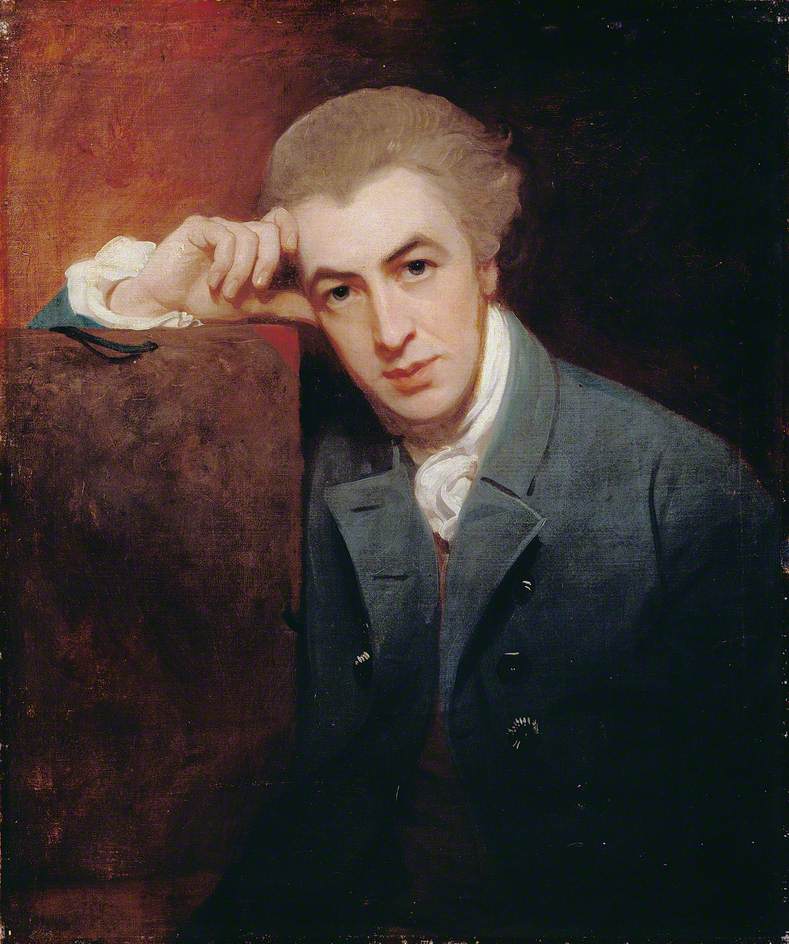
    Introducing William Hayley

    Although now – unless you’re a Blake aficionado or an 18th century specialist – you’re unlikely to have heard of William Hayley (1745-1820), in his time he was highly influential.

    Alongside reams of poetry, a dozen or so unsuccessful plays, a slew of verse and prose essays (he was the first person to publish any of Dante’s work in English), and one novel, Hayley wrote one of the late eighteenth century’s bestselling self-help books: The Triumphs of Temper, advising young women on how to attract and keep a husband. It was written in rhyming couplets and modelled on Pope’s The Rape of the Lock.

    Despite this success, his own marriages – he wed twice – were not happy. His first wife, who, in his memoirs he often describes as his “pitiable Eliza”, suffered from “marvellous mental infelicities”  which, in Hayley’s telling, led, ultimately, to their separation.

    Little is known of his second marriage, except that it lasted under four years and ended with a case in the Doctors’ Commons. However, I’m in the process of trying to decipher a heavily redacted letter Hayley wrote to a friend in 1816 in which he describes himself as having been lured or tricked

    into a calamitous marriage by a subtle plot between two beautiful sisters & a hypocritical Presbyterian all of whose artful machinations [illegible] I have lately discovered

    More to follow when I’ve completed my detective work.

    Hayley also functioned as an amateur doctor, treating the villagers around his home in Eartham, Sussex, where he was well loved, and was proud of never having killed anyone.

    He also had a particular interest in the relationship between mental health issues and creativity, and took an active part in supporting, and attempting to cure, William Cowper, George Romney, Joseph Wright of Derby and Charlotte Smith amongst others (he also, on occasion, negotiated book deals for Smith).

    Hayley coaxed William Blake to Sussex from London in 1800 and provided – as the antithetical element in Blake’s dialectical approach – inspiration for some of his prophetic poetry. It’s also likely that, in standing bail for Blake when he was tried for sedition in 1804, hiring a lawyer and speaking for him in court, he saved the visionary’s life. Sedition, after all, carried the death penalty.

    For a combination of political and health reasons, in 1790 Hayley turned down Pitt’s offer of the poet laureateship. After his own, unpleasant experiences at school – he nearly died at Kingston Grammar and was bullied and beaten at Eton – he paid close personal attention to the education of his son Thomas Alphonso (whose mother was neither of Hayley’s wives), which was mostly undertaken at home in Eartham, West Sussex where he also tutored some of his friend and neighbour, Lord Egremont’s children.

    He died aged 75 in 1820.